
She Spent Years Wishing Her Skin Away—Then Her Sister Took a Photo


Joelle Powell was twelve years old when she covered herself in self-tanner for her brother’s wedding. She wanted to look “normal” for the photos—or at least closer to it. She was already used to hiding, already fluent in the particular exhaustion of managing other people’s reactions to her skin before they could have them.
She had been living with vitiligo since she was four. By the time she was twelve, it had spread quickly—across her body, her hands, her face—before stabilizing around age ten. She grew up in San Antonio, Texas, in the heat, with dark olive skin that made the contrast impossible to miss. She thought about it constantly.
“I always did not like it,” she says now, from a life that looks almost entirely different. “I covered it, wished every year on my birthday that it would go away and I wouldn’t have to deal with it anymore.”
She was homeschooled for most of her childhood, isolated in ways that meant there was no one to ask questions of, no peers who might have made her feel less alone in it. Her little brother would eventually develop vitiligo too—around his eyes and hips, more gradually—but at the time, she was navigating it largely on her own, without language for what she was carrying.
The turning point didn’t arrive with a dermatologist visit or a viral post or a sudden awakening. It arrived in 8th grade, quietly, in the form of a decision she made mostly because she was tired.
“I was just sick of living like this,” she says. “I needed to do the mental work to love myself. I was done hating myself.”
Around that same time, she started spending more time with her older sister—and her sister did something that sounds small but wasn’t. She took pictures of Joelle. She told her she was beautiful. She looked at her skin and didn’t flinch or redirect or cover it over with reassurance. She just named what she saw.
“She was the first person who did that for me,” Joelle says.
She was fifteen when she got her first phone. She started doing her own research—opening up a browser and reading about vitiligo, on her own, for the first time—and found that so much of what she’d been told and believed about her skin wasn’t true.
That reclamation has taken years. It still isn’t finished—Joelle would be the first to say that. But she’s now 24, a young mom of two in San Antonio, a full-time influencer who spent three years building an audience before 2025 became the first year she made real money doing it. Her content covers outfits, hair tutorials, DIY home projects, what it looks like to be a young married mom. And vitiligo. Always vitiligo.
She self-tans today—not to cover the patches, but to make them more visible. She matches her foundation to blend, not conceal. She takes detailed photographs of her skin and posts them for her followers. She answers DMs from women who tell her she’s the first person with vitiligo they’ve ever felt good following.
“That’s why I post,” she says. “That’s why I started.”
She still lives in Texas. Some days are harder than others. The work doesn’t end. But she’s not wishing her skin away anymore.
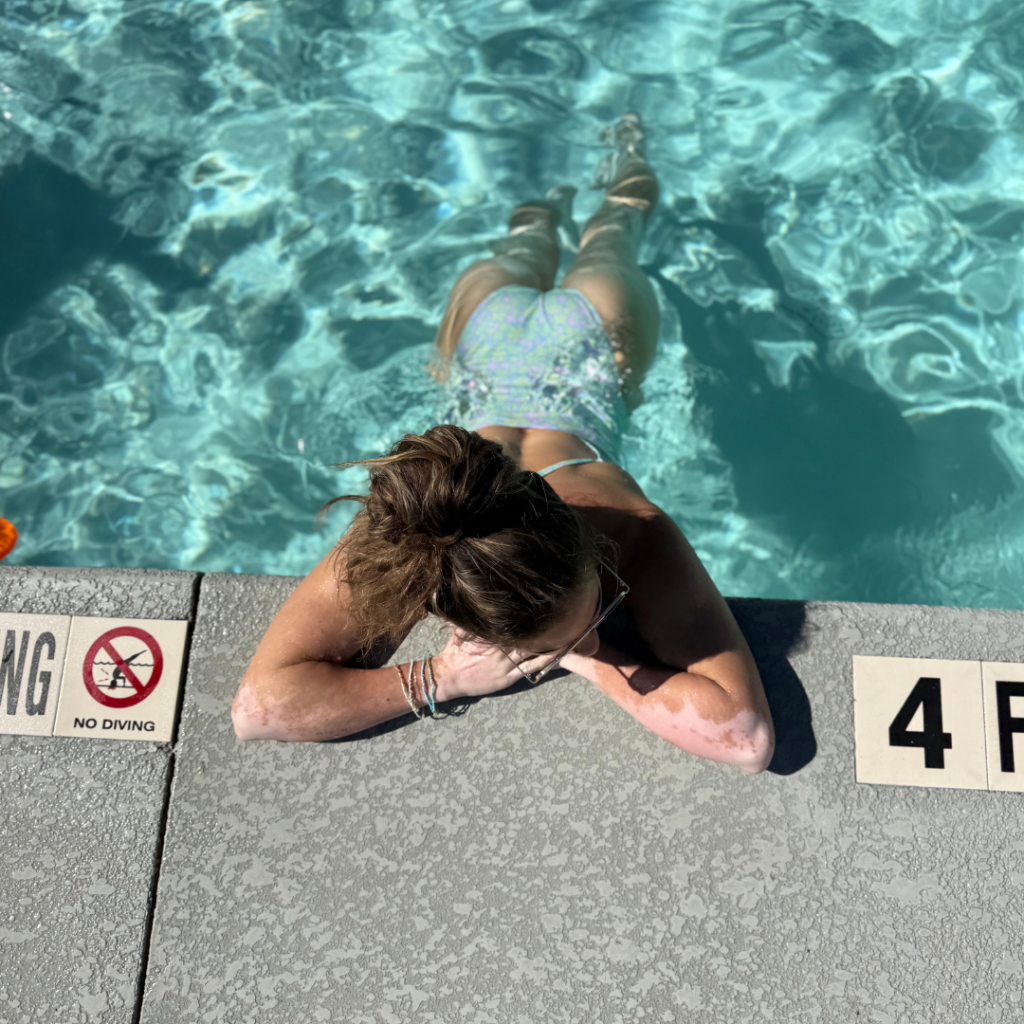
A Conversation with Joelle Powell
We talked with Joelle about growing up with vitiligo, the sister who changed everything, and what it actually means to be a self-love advocate when some days are still complicated.
Name: Joelle Powell
Hometown: San Antonio, Texas
Age: 24
Diagnosed at: 4
Living Dappled: You were diagnosed at four. What’s your earliest memory of knowing your skin was different?
Joelle Powell: Going to the dermatologist and getting diagnosed. I remember my mom being very stressed and worried. There wasn’t a lot of calm or positivity around it—I knew something was wrong with me. Growing up with that mindset was hard, especially since my siblings didn’t have it at the time.
LD: You’ve talked about how fast it spread. What was that like physically and emotionally?
JP: It was fast—all over within about two years. Then it slowed down and stayed pretty stable, except during high-stress times. I felt uncomfortable immediately, because of the way the people around me dealt with it. I thought about it constantly. It’s hot in Texas, and I have dark olive skin—there was no hiding it, even when I was trying to.
LD: You mentioned a turning point in 8th grade. Can you take us there?
JP: I just got to a point where I was sick of living like that. I decided I needed to do the mental work to actually love myself—to not let my skin choose my life for me. I was done hating myself. It sounds simple when I say it now, but it was a real decision. It took a lot.
LD: Your sister comes up a lot when you talk about that time. What did she do that mattered?
JP: She just spoke positive things into my life. She’d say, “You’re beautiful, you’re unique”—and then she’d take a cute picture of me. She was the first person who looked at me and made me feel beautiful. She’d take detailed photos of my skin. She saw it as something worth documenting, not hiding. I felt beautiful for the first time because of her.
LD: You also got your first phone around that age and started doing your own research. What did you find?
JP: I just opened Safari and started looking things up. I wanted to understand what was actually going on with my skin. And I realized a lot of what I’d been told or believed wasn’t true. That was huge for me—being able to find real information on my own.
LD: Today you describe yourself as a lifestyle influencer. How does vitiligo fit into that?
JP: It’s a big part of what I share—alongside outfits, hair tutorials, mom life, home stuff. But vitiligo is always there. I post about it intentionally. I take detailed photos of my skin for World Vitiligo Day. I want people to see it and not look away. I also have a lot of moms and people with vitiligo in my community, which I love. That community matters to me.
LD: You self-tan and you’ve talked about how you approach makeup with your vitiligo. Can you walk us through that?
JP: I think my vitiligo is pretty. I self-tan to make it more noticeable. On my face I blend my foundation to match — not to cover, just to match. I don’t mind that my face is mostly white. I’m not covering it. I’m just living in it.
LD: When women DM you to say you’ve helped them, what do they usually say?
JP: That they love following me. That they love seeing me confident. That I help them see the beauty in vitiligo and in who they are. That’s why I do it. That’s the whole point.
LD: What do you want women who are earlier in their journey to know?
JP: That you don’t have to let your skin choose your life. I spent so many years doing that—hiding, wishing, covering. And I know it’s not as simple as just deciding to stop. It took real work. It took my sister telling me I was beautiful. It took getting a phone and finding out the truth about my own body. But the work is worth doing. It doesn’t end—some days are still hard. But you don’t have to live in that hiding place forever.
LD: And your brother—he has vitiligo too now. Do you talk about it?
JP: We’re pretty close. His isn’t very noticeable—around his eyes and on his hips—but he doesn’t love it either. I think that closeness helps, even when we don’t talk about it directly. Just knowing someone else in your family is in it with you means something.
Joelle Powell is based in San Antonio, Texas. You can follow her on Instagram @joelle_powell.


