Winnie Harlow on Bullying, ‘That’s None of Your Business,’ and Writing Simply Winnie


Four kids with vitiligo—and supermodel Winnie Harlow. That was the line up on this year’s World Vitiligo Day-USA stage on a Sunday morning in Charlotte, NC.
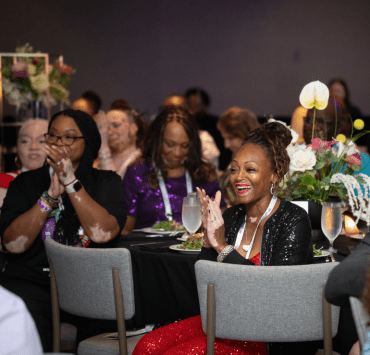
WVD-USA is an annual, three-day conference for those with vitiligo hosted by the Global Vitiligo Foundation. By Sunday morning, Winnie had already spent the previous two days celebrating alongside attendees at the WVD-USA event and signing books and creating crafts alongside the youth attendees. This final interview was another opportunity to engage with the kids.
In a session called “In Her Own Skin: A Conversation with Winnie Harlow Through The Eyes of Children,” four kids with vitiligo—Abby, Cameron, Alana and Elijah—had the chance to ask Winnie about her experience with vitiligo, her new book Simply Winnie, and her advice for other kids learning to embrace their uniqueness.
A model, entrepreneur and public figure, Winnie Harlow is one of the most famous people living with vitiligo today, and is known for her role in redefining beauty standards. She’s also now the author of a children’s book—Simply Winnie—which shares a message about uniqueness and the importance of self-love.
For Abby, a rising high school senior who got vitiligo at the age of 11 and the session moderator, this was a once in a lifetime experience. In her words: “Living with vitiligo feels like a lot right now—it was cool to hear from someone who has lived with it from childhood to adulthood and can tell us it’s going to be okay.”
For thirty minutes, the panel of kids asked Winnie about her childhood, her book and her advice. Winnie talked about what bullying actually felt like at her age, how she handled comments and stares, and what led her to write Simply Winnie, a children’s book built so kids with visible differences don’t have to be “the token.”
Here’s what the kids asked Winnie—and her inspiring responses.
Live WVD-USA Interview with Winnie Harlow
Abby: We are so excited to have you back at World Vitiligo Day this year and to spend time with you again. Cameron is going to lead us off with the first question for you.
Cameron: What was it like to experience last year’s conference, and what made you want to come back this year?
Winnie: For me, last year was a brand new experience—I had never been. I feel like so many of us have had this experience—I’ve never been in a room full of people who look just like me. That’s something my younger self would have loved to experience. Walking into a room and not feeling like I have to explain or like I’m being questioned or feel like an outsider. My experience last year was healing for my childhood self. It was really a no-brainer for me to come this year. The community here is so warm. It really feels like a family. And I’m grateful that I was able to do year two for myself.
Abby: Winnie, you recently opened up about your childhood and what it was like growing up with vitiligo. We have some questions for you about that phase of your life.
Alanna: What was the hardest part about having vitiligo when you were young? How did you handle mean comments or people staring?
Winnie: The hardest part for me growing up was really the bullying. When I was younger and not yet in school, my family made it their mission to make sure that I felt beautiful. And so I never really felt different when I was much younger—it wasn’t until I got into school and started getting bullied and called names. I think the hardest part was figuring out the step between relying on what other people said about me as my north star and figuring out, or re-figuring out, that my opinion of myself was the most important. Because I think that was given to me as a child from my family, my friends—everybody always instilled in me that I was good enough, I was beautiful. But once you get to that school age, you kind of start to forget that. When there’s kids around and maybe you like a boy, and he doesn’t like you back… all the little things that kids deal with in school. Finding myself again through that process and remembering that I am enough—and my opinion of myself is the most important—was helpful.
Elijah: When you were young, how did you deal with comments and stares?
Winnie: My grandmother has a story—when I was maybe 7 or 6 years old—she took me to go and pick up my cousin from school and a kid said, ‘What’s that on your face?‘ And she said I took the child by the chin and said, ‘Honey, that’s none of your business.’ So you can see the type of child that my grandparents and my mom raised. At the time, I don’t think I really understood it either, so I didn’t have a way to explain. But what I did know at that very very young age was—it was nobody’s business. As I got older though and as there’s been more education, I’m able to better explain, but at a young age, I don’t think we had as much education as you guys do have, which is amazing.
Cameron: What advice would you give to kids or teens about how to get started in the fashion and entertainment industry in order to make a difference?
Winnie: For me, I think the most important thing I’ve learned is—there’s no ‘I’ in team. As much as you see me in beautiful clothes on the runway, a designer made that. If you see the children’s book that I made, my team had a hand in that. Finding very reliable people you can trust is the most important thing when it comes to any business. Anything you want to do, whether it’s fashion or runway or film or anything in entertainment—[what’s important is] doing the research. For me, when it came to modeling, I had no idea what I was doing… I didn’t know what I was doing behind the camera, I didn’t know what I was doing on the runway. But I would study. I would look up “the greats” and watch what they were doing and put my own twist on it so it was unique to me. If that comes to film, going to school for film, or doing your due diligence so you are the most valuable person in the room, not just by looks or whatever, but by brain as well.
Elijah: What is it like having vitiligo as an adult and is it different from when you were a teenager?
Winnie: I would assume it’s much harder getting vitiligo later on in life, because you’re so used to one look of yourself—you’ve lived your entire life looking one way. And so I have a lot of love in my heart for people who have experienced vitiligo at a later age. Because it’s really all that I know. And while it was hard, there’s no alternative for me in my brain.
As a child it definitely was difficult because you’re in that inbetween place of even knowing who you are. As an adult, I feel like it’s much easier for me. It’s not really about looks anymore, it’s more so about health. I don’t look towards any cure or anything when it comes to the physical aspect of it, but when it comes to health, because it is an autoimmune disorder, we can be susceptible to other autoimmune disorders.
Abby: Winnie, you’ve recently celebrated a huge accomplishment—you are now a children’s book author. We’d love for you to share with us about your new book Simply Winnie. What inspired you to write Simply Winnie?
Winnie: When I was growing up, I was a big reader. I really loved to read and I loved that books could take you to a different world. And also, I’m a millennial, so I’m the generation that’s right between the playing outside and the video games and the streaming, and all that. So books for me were really big growing up because we had dial-up internet, it wasn’t giving high speed. It was my entertainment, other than TV and playing outside. I loved that books could take you to a different world. I would get so wrapped up in books and have my night light on and read on the side of my bed.
I realized that there were some books—my family, my mom would get me—that would be about kids who had differences, whether it was someone who had freckles or someone in a wheelchair, or someone who had vitiligo. I realized too, earlier, how it made me feel that the story was about their difference and not just about them being. I feel like so many times, as somebody who’s different, you kind of get tokenized. It kind of becomes the thing—I’m different and that’s my thing. No, there’s so much more to me. I’m dynamic, I’m a human being. There’s so much more to me.
I wanted to create a world in books where kids have differences—there’s a little kid who has a hearing aid, there’s a little kid who’s in a wheelchair in the class. I’m from Toronto, my classroom was diverse—we had little kids in their turbans and bindis and we had international days and we learned about different cultures. And I thought that was a beautiful experience for a child to have. So in my book, I wanted to create a world where you were exposed as a child to people who were different, but the story didn’t have to be about that specific physical difference. There’s so many more to talk about with kids, and I think that’s more important.
Alaina: In your book, you did not talk only about vitiligo, but you included people with other differences. Why was that important to you?
Winnie: Like I said earlier, I experienced that myself growing up. I wish when I was growing up, that other people experienced someone who looked like me before they met me. So I didn’t have to be the token, to be like—okay, every single time, this is what it is, this is this, dah-dah-dah. It’s also important for people to educate themselves as well. It shouldn’t always be on us to have to educate about vitiligo or any experience that we have in life.
Elijah: If little Winnie could have read this book, how would it have helped her?
Winnie: I think it would have helped her a lot. For me, growing up, I didn’t have any sort of representation. I’d never seen someone who looked like me on covers, or in a book, or in any place. To just see a character that looked like me but it being a norm, rather than it being the thing—“Like oh, look at me, I’m sad because I have vitiligo.” Winnie is very happy in the book. She’s very happy, she’s very bright, bubbly, and confident—as she should be. And that’s something I would have loved to see growing up.
Cameron: When a person reads Simply Winnie, what do you want them to remember the most?
Winnie: When someone reads Simply Winnie, I want them to remember that they are bold, they are beautiful. That’s kind of the character of Winnie herself, and I hope that kids, whether they have vitiligo or not, see her in themselves.
Abby: Winnie, is there anything else you’d like to share before we close?
Winnie: I am so grateful for this room. I appreciate you guys all welcoming me and this family dynamic all coming together. I think that what you guys are doing is incredible, and is opening the door for so much change and for the younger generation to not deal with the things we had to deal with earlier on, when we had less education. Seeing even yesterday, the awards that are being given for ingenuity, and the efforts that are being put into the cure—not just about the physical aspect, but about the health aspect. I think it’s so beautiful. You guys have all the power, and that is because of you, because you show up, because you show face, because you are proud of who you are, and because you care for each other. So, I thank you guys.
This piece is part of a series from Living Dappled’s coverage of WVD-USA, hosted by the Global Vitiligo Foundation.
Some links on this page are affiliate links. If you shop through them, we may earn a small commission—at no cost to you. We include only products that this community genuinely uses and loves.